UtilityGap
A local-first desktop research tool for finding simple utility web-app niches with measured search demand and weak Google competition.
Technologies Used
About This Project
Overview
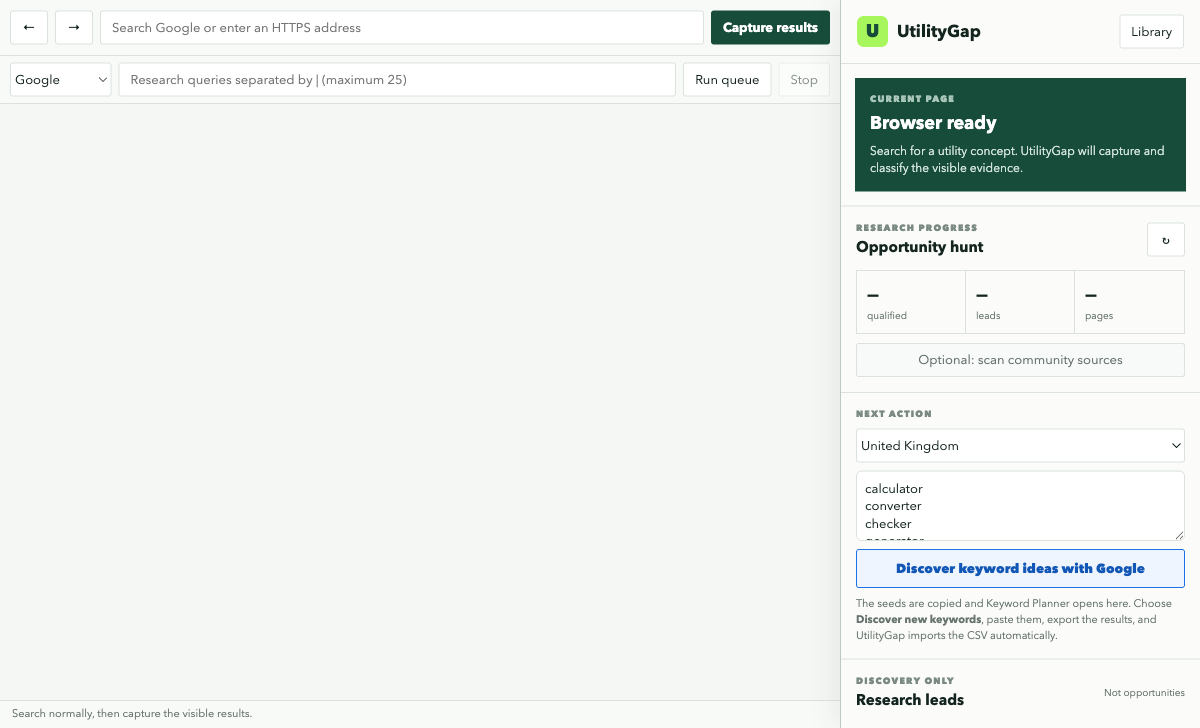
UtilityGap is a personal desktop research application I am building to identify focused utility web apps—calculators, converters, checkers, generators and estimators—that may attract organic search traffic and support a display-ad business model.
The project replaces guesswork with a reviewable evidence pipeline. It separates keyword discovery from validation and does not label a keyword as a build opportunity until both demand and the current search results have been examined.
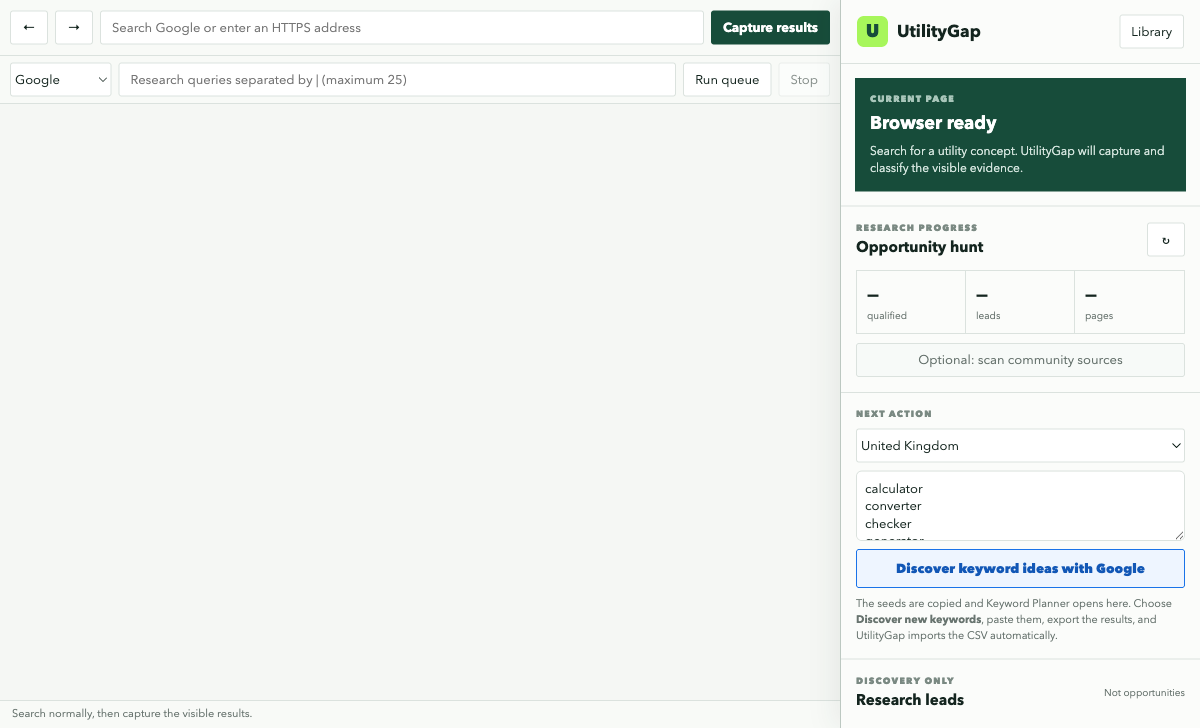
How the research workflow works
- Begin with broad utility seeds such as
calculator,converter,checker,generatorandestimator. - Expand those seeds in Google Keyword Planner for a selected country and import the resulting historical metrics.
- Filter the measured ideas to standalone, non-regulated utility intents with meaningful monthly demand.
- Inspect live organic search results in a visible embedded browser rather than relying on an invented competition score.
- Classify direct utility competitors, measure result saturation and use public RDAP records to identify young domains already ranking on page one.
- Present the observed evidence and reject candidates whose demand or ranking path remains unproven.
Google Ads and Keyword Planner usage
The current application uses the authenticated Google Keyword Planner interface and imports a CSV explicitly downloaded by the account holder. UtilityGap does not read or store a Google password, bypass authentication, solve CAPTCHAs, create campaigns, place ads or make billing changes.
I am evaluating an official Google Ads API integration for keyword ideas and historical metrics. It will only be enabled if Google approves the application and intended use. Authentication would use Google's OAuth flow; the desktop application would never collect the user's Google credentials.
Data sources and provenance
- Google Keyword Planner exports: country-specific keyword ideas, average monthly searches and bid ranges.
- Visible organic results: titles, destination URLs, snippets and positions captured from searches initiated in the desktop browser.
- Public RDAP records: domain-registration dates used as one signal that a newer site can enter a result page.
- Optional public discussions: supporting vocabulary and problem evidence only, never a substitute for measured search demand.
Every stored observation retains its source and collection time. Unknown values remain unknown; the application does not manufacture search volume, traffic, revenue or domain-authority figures.
Privacy and security
UtilityGap is currently a single-user, local-first desktop application. Research data is stored in a local SQLite database on the operator's computer. It is not sold, shared with advertising networks or uploaded to Funcoder.
If OAuth access is added, refresh credentials will be encrypted using the operating system's secure credential storage, access will be limited to the minimum Google Ads scope required, and the user will be able to disconnect and remove stored access locally.
Current status
The browser-first MVP is under active development. Keyword Planner import, visible SERP capture, result classification, public domain-age research and fail-closed opportunity scoring are implemented. Current work is focused on expanding first-party keyword discovery and validating the scoring thresholds against real research campaigns.
UtilityGap is an internal project and its source repository is private while the research workflow is being validated. Questions about the project or its data handling can be sent to jb@funcoder.com.